Digital Instructions for Use.
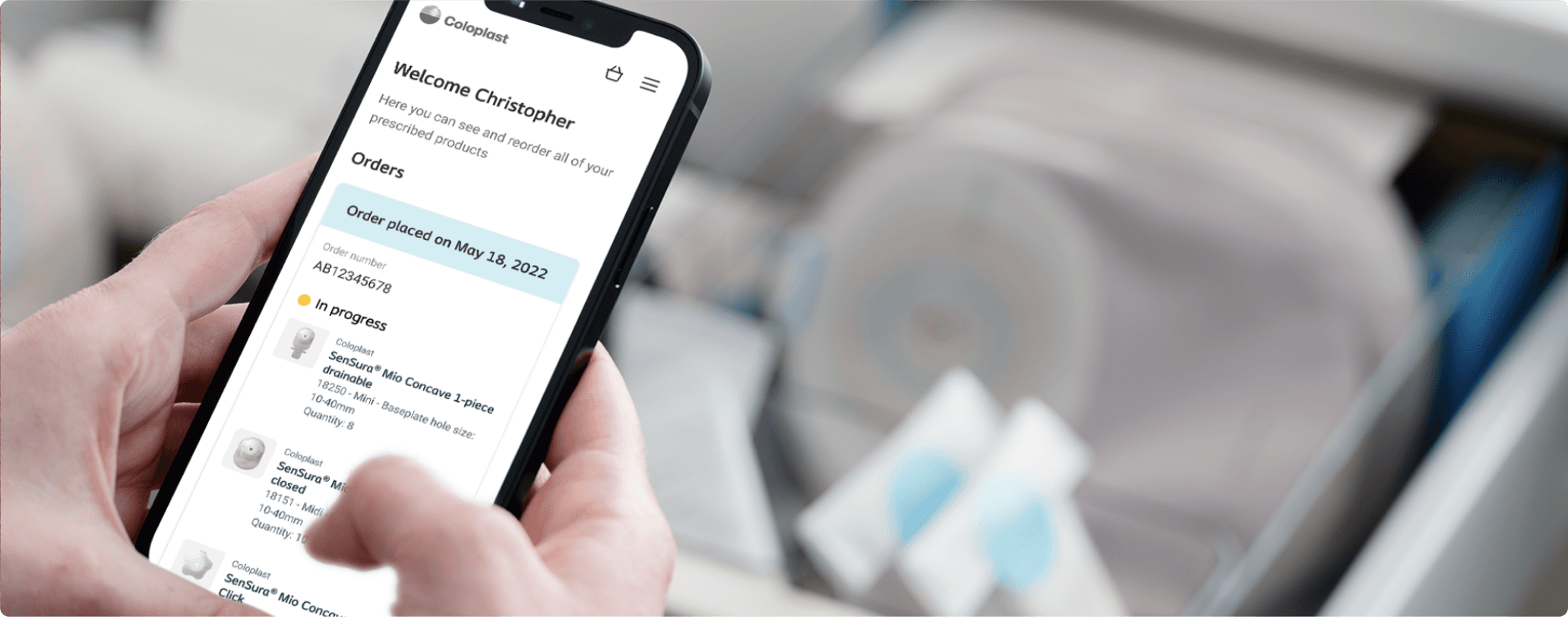
We reimagined how people interact with medical guidance by designing a device-agnostic digital instructions platform
Digital Instructions for Use.
We reimagined how people interact with medical guidance by designing a device-agnostic digital instructions platform
Due to a NDA, this case study uses anonymized content and simplified visuals, focusing on process and decision making.
To know more, please reach out.
My contribution
Role: Advanced UX/UI Designer
Team: User Researchers, UC Designer, Design Lead
Timeline: 18 months
Disciplines: Research design, analysis, and interaction design.
Context and Problem
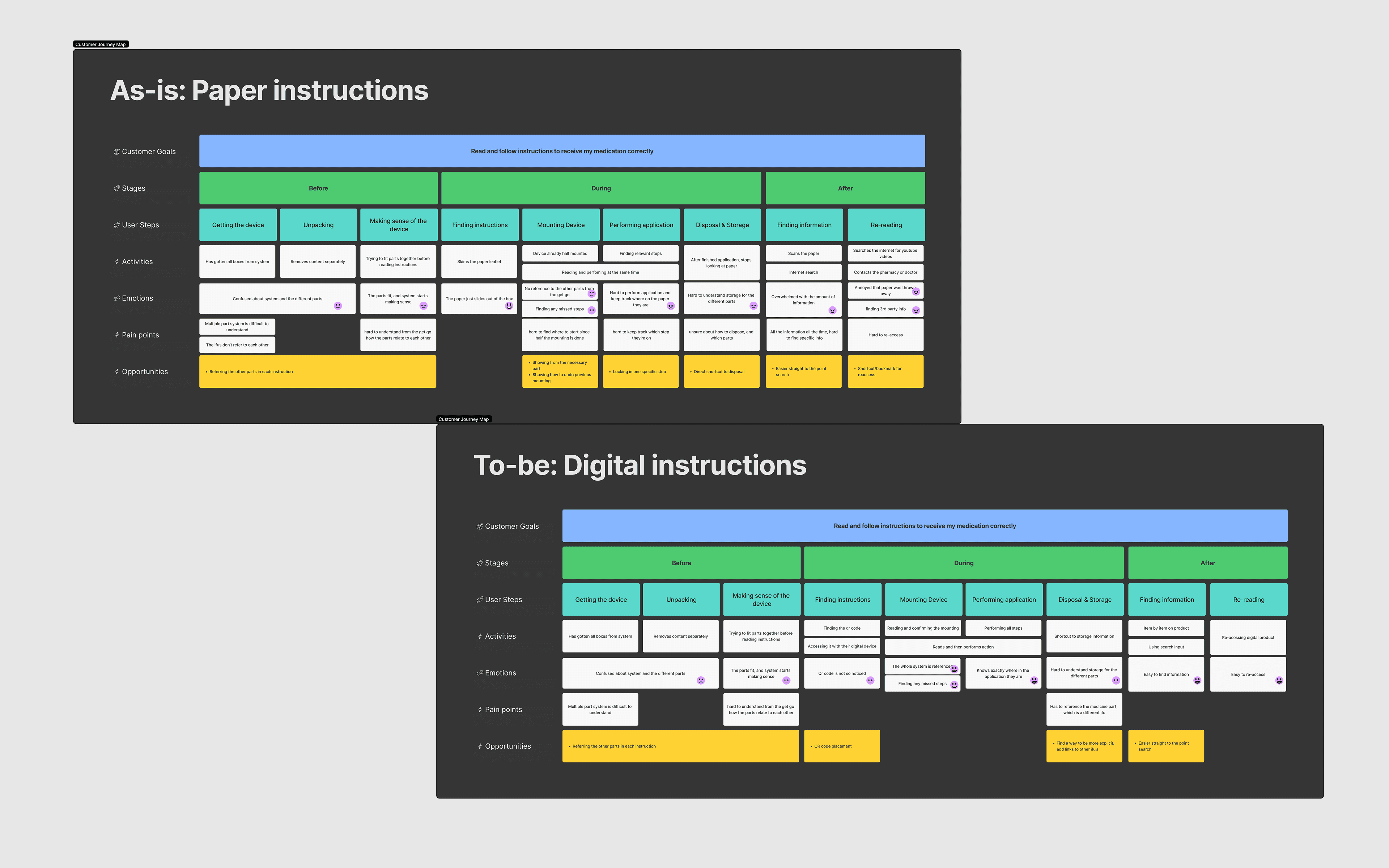
Medical instructions are traditionally paper-based, dense, and reportedly overwhelming.
Moving them into a digital format can introduce new risks: more interaction, and more opportunities for confusion during a high-stakes task.
The business goal was to design a device-agnostic digital instructions platform that supports safe task completion, and can scale across products under regulatory constraints.
Challenges and How We Explored Them
Clarity vs. regulations
We had to navigate the reality of Software as Medical Device, which is a heavily regulated area. We had to find compromises on how to shape the digital experience, taking that into consideration
Accessibility
Since this was the conceptual phase, no developers were allocated. To make sure we were prioritizing accessibility, one of the main experience pillars for this solution, we conducted regular accessibility auditing, on top of making it a priority in our usability tests.Blend of physical and digital experience
Digital interaction enabled flexibility, but the task required focus. We intentionally limited options to preserve a clear, step-by-step flow.
Key decisions + design principles
Research consistently pointed toward a small set of principles.
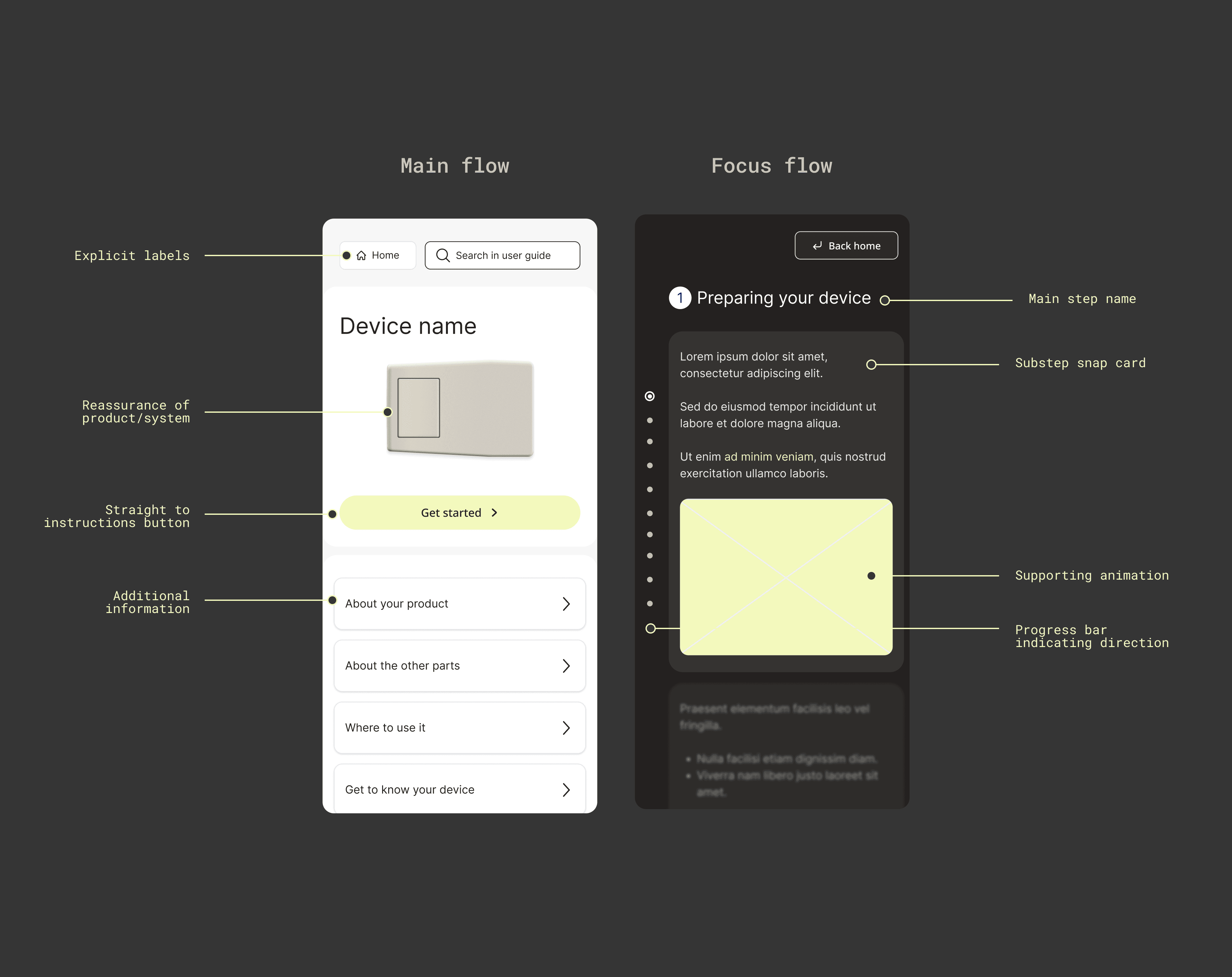
Design for action, not exploration
This is a product for performing a task, not for browsing. Therefore, the main user will always be a 'new' user, since the instructions will be familiar with time.Safety first, smoothness second
Any competing cues are removed to improve focus and insure safety. The flow will be 'broken' if that improves safer application, even if that frustrates users.Context over overview
Tablet and desktop behaviour mirrored mobile, even though there is more space to add a feeling of overview, making sure the core experience is aligned.Explicit beats industry-standard
Clear labels and direct language reduced user hesitation more than conventions.
Guerilla Test
Usability Test
Workshops
Final Validation
We conducted one last usability test as the final validation. It tested the effectiveness of the solution and pointed towards any necessary final adjustments.
The usability test was a combination of qualitative task-based sessions and quantitative knowledge tasks to assess both in-the-moment behaviour and critical information findability.
The study confirmed the overall experience and validated the impact of the latest refinements, including clearer navigation cues, simplified progress indication, more explicit wording, and improved content placement.
Test Group
Interview
Analysis
Outcome & Impact
Deliverables
A scalable digital instructions platform design
Communication and Ops. guidance
Design principles guide
Impact
Correct answers on the knowledge tasks increased by 57 percentage points after the final validation.
All participants followed the instructions correctly, not missing any critical step.
The flow was consistently referred as simple and easy to use.
"It's easy to use, it was step by step. Next step, next step, next step [...] I found it straightforward"
My contribution
Role: Advanced UX/UI Designer
Team: User Researchers, UC Designer, Design Lead
Timeline: 18 months
Disciplines: Research design, analysis, and interaction design.
Context and Problem
Medical instructions are traditionally paper-based, dense, and reportedly overwhelming.
Moving them into a digital format can introduce new risks: more interaction, and more opportunities for confusion during a high-stakes task.
The business goal was to design a device-agnostic digital instructions platform that supports safe task completion, and can scale across products under regulatory constraints.
Challenges and How We Explored Them
Clarity vs. regulations
We had to navigate the reality of Software as Medical Device, which is a heavily regulated area. We had to find compromises on how to shape the digital experience, taking that into consideration.
Accessibility
Since this was the conceptual phase, no developers were allocated to the project. To make sure we were prioritizing accessibility, one of the main experience pillars for this solution, we conducted regular accessibility auditing, on top of making it a priority in our usability tests.Blend of physical and digital experience
Digital interaction enabled flexibility, but the task required focus. We intentionally limited options to preserve a clear, step-by-step flow.
Key decisions + design principles
Research consistently pointed toward a small set of principles.
Design for action, not exploration
This is a product for performing a task, not for browsing. Therefore, the main user will always be a 'new' user, since the instructions will be familiar with time.Safety first, smoothness second
Any competing cues are removed to improve focus and insure safety. The flow will be 'broken' if that improves safer application, even if that frustrates users.Context over overview
Tablet and desktop behaviour mirrored mobile, even though there is more space to add a feeling of overview, making sure the core experience is aligned.Explicit beats industry-standard
Clear labels and direct language reduced user hesitation more than conventions.
Deep dive on the methods we used that led to these decisions:
Guerilla Test
Guerilla Test
Usability Test
Usability Test
Workshops
Workshops
Final Validation
We conducted one last usability test as the final validation. It tested the effectiveness of the solution and pointed towards any necessary final adjustments.
The usability test was a combination of qualitative task-based sessions and quantitative knowledge tasks to assess both in-the-moment behaviour and critical information findability.
The study confirmed the overall experience and validated the impact of the latest refinements, including clearer navigation cues, simplified progress indication, more explicit wording, and improved content placement.
Deep dive on the study design for the final validation:
Test Group
Test Group
Interview
Interview
Analysis
Analysis
Outcome & Impact
Deliverables
A scalable digital instructions platform design
Communication and Ops. guidance
Design principles guide
Impact
Correct answers on the knowledge tasks increased by 57 percentage points after the final validation.
All participants followed the instructions correctly, not missing any critical step.
The flow was consistently referred as simple and easy to use.
"It's easy to use, it was step by step. Next step, next step, next step [...] I found it straightforward"
Check out other projects